If you've ever had a combi oven delivered only to find out it can't be plumbed in, wired up, or vented on installation day, you're not alone. It's one of the most common, and most avoidable hold-ups we see. This guide walks through exactly what your kitchen needs before your oven arrives: power, water, drainage, and ventilation.
If you're not sure about any of this, our team will help you survey your kitchen before you buy, but knowing the basics up front will save you time either way.
1. Power Supply: Single Phase or Three Phase?
This is the question we get asked most, and it's the one that catches people out most often.
Single phase (230V) is the standard domestic and light-commercial electrical supply — the same type of power most ovens, grills, and kitchen equipment run on. Smaller combi ovens (typically 6-grid and below) are often available in single phase.
Three phase (400V) delivers power across three live wires instead of one, allowing much higher loads to run efficiently. Most combi ovens from 10-grid upwards, and virtually all larger models, require three phase, simply because a single-phase circuit can't carry enough current without needing enormous cabling.
How to tell which you have:
- Look at your consumer unit / distribution board. A single-phase supply typically has one incoming main switch. A three-phase supply usually has a larger board with three (or four, including neutral) incoming connections, often feeding a bigger cluster of breakers.
- Your electricity bill or meter can also indicate this — three-phase meters look different from standard single-phase meters and are common in commercial kitchens, larger pubs, and hotels.
- When in doubt, ask your electrician or contact us — a photo of your consumer unit is usually enough for us to confirm.
Why this matters before you order: every combi oven has a rated power load (kW) and a specified electrical connection. If your kitchen only has single phase and the oven you want requires three phase, you'll need an electrician to upgrade the supply — which can mean working with your Distribution Network Operator (DNO), not just a rewire. This is worth checking before your oven is delivered, not on installation day.
2. Water Supply: What Combi Ovens Need
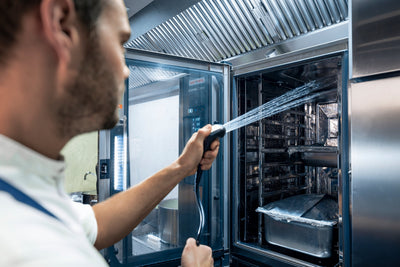
Combi ovens use water for steam generation and automatic cleaning cycles, so a plumbed water connection is essential for anything beyond the smallest boiler-fill models.
Connection type: Most combi ovens need a cold water supply at mains pressure, connected via a standard fitting (often 3/4" feed), with an isolation valve fitted nearby so the oven can be shut off for servicing.
Water quality matters more than people expect. Untreated mains water in hard water areas (which includes much of Kent and the South East) causes limescale build-up inside the boiler and steam generator — this is the single biggest cause of avoidable breakdowns and costly descaling callouts. Most manufacturers, including Rational, specify a maximum water hardness level and often require filtration or softening as a condition of the warranty.
We've written a full breakdown of this in our Limescale and Water filtration guide — worth a read if you're in a hard water area (most of the UK is).
What you'll typically need:
- A dedicated water line with isolation valve
- A filtration or softening system appropriate to your local water hardness (your water provider can tell you your local hardness level)
- Confirmation that your setup meets the manufacturer's warranty requirements
3. Drainage: Where Does the Water Go?
Combi ovens produce condensate and waste water from steam generation, cleaning cycles, and cooling — this needs somewhere to go.
Gravity drain vs pumped drain: If your oven can be sited above or level with a suitable drain point, a simple gravity waste connection is enough. If the drain is lower than the oven outlet, or there isn't a nearby drain at all, a pumped drain kit lifts the waste water to where it needs to go — this is common in kitchens where the oven sits away from existing plumbing.
Temperature matters: Waste water from a combi oven can come out hot, and building regulations often require it to run through a tundish or cooling arrangement before joining standard drainage, protecting downstream pipework.
What to check:
- Is there an existing drain point within reasonable reach of where the oven will sit?
- Is it above, level with, or below the oven's drain outlet? This determines whether you need a pump.
- Does your setup allow the waste to cool before entering shared drainage?
4. Ventilation: Extraction Requirements
This is the area with the most flexibility — and the most confusion.
Direct extraction (ducted): The oven connects into a ducted extraction system that removes steam and heat directly to the outside, usually via a canopy or dedicated spigot connection. This is the traditional approach and works well where ducting already exists or can be installed.
Condensate hoods / ventless options: Many modern combi ovens can be fitted with a self-contained condensing hood that captures and cools the steam before releasing it, removing the need for external ducting. This is a popular solution where structural ducting isn't practical — mobile catering units, listed buildings, or kitchens without existing extraction infrastructure.
What determines which you need:
- Whether you have existing ducted extraction and canopy coverage
- Local building control and fire regulations for your premises
- Grid size and usage volume — heavier daily use generates more steam load
- Structural constraints (ceiling height, existing ductwork routes, listed building restrictions)
We go into more depth on this in our dedicated Ventilation Requirements Guide, including how to work out canopy coverage for your specific oven size.
Putting It All Together: A Quick Pre-Installation Checklist
Before your combi oven is delivered, it's worth confirming:
- Power - single or three phase confirmed, and matches the oven's electrical requirements
- Water - plumbed cold supply with isolation valve, and appropriate filtration/softening for your water hardness
- Drainage - accessible drain point, with pump if needed, and cooling arrangement for hot waste water
- Ventilation - either ducted extraction with adequate canopy coverage, or a condensate hood suited to your kitchen layout
- Space and clearance - enough room around the unit for servicing access and door swing
Not Sure Where You Stand?
This is exactly the kind of thing that's much easier to sort out over a phone call or site visit than to guess at. If you're planning a combi oven purchase, rental, or replacement and you're not sure what your kitchen currently supports, get in touch — we can talk through what you've got and flag anything that needs sorting before delivery day, so there are no surprises.