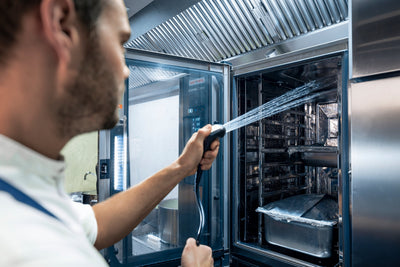
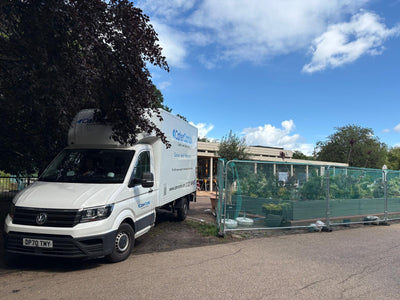
Almost every combi oven installation that goes wrong, happens for the same reason: nobody checked the site before the oven turned up.
We've been supplying and installing combi ovens from our Canterbury warehouse since 2013, and the pattern is remarkably consistent. The engineer isn't the bottleneck. The doorway is. Or the breaker. Or the drain that's three metres from where the oven needs to stand.
Before your oven arrives, make sure that it can physically reach its position, that the power, water, drainage and extraction it needs are already there and correctly rated, and that there's enough room around it to service it. Get those right and installation is a couple of hours. Get one wrong and it's a second visit.
Here's what we check, and what you should check before you combi oven is delivered.
Can the oven actually get into the kitchen?
This is the one that catches people out most often, and it's the most expensive to get wrong, because an oven that can't get in has to go back on the lorry.
Measure the whole route, not just the kitchen door. Entrance width, corridor turns, thresholds, any step, any lift, and any fixed obstacle you've stopped noticing: a fire extinguisher bracket, a low pipe run, a serving hatch frame.
A 6-grid tabletop unit will go almost anywhere. A floor-standing 20-grid is a different conversation entirely, and a tight 90-degree corner at the bottom of a stairwell has beaten bigger ovens than yours.
Where access is genuinely tight, uncrating off site before delivery buys you several inches and saves you a kitchen full of packaging on a trading day.
Does your kitchen have the right electrical supply?
Two questions here, and both need answering before the oven leaves us.
What's the supply? Most electric Rational combis are specified for 400V three-phase. Some compact models can be ordered single phase, but that has to be specified at the point of order — it isn't something that can be changed on site.
What's the circuit rated at? Having three-phase in the building isn't the same as having spare capacity on a correctly rated, correctly protected circuit at the oven's position. If you're replacing an older or smaller unit, don't assume the existing circuit is adequate for the new one. Check the amperage against the spec sheet.
You'll also need to know how it's being connected (isolator, socket or hardwired) and have an electrician booked. Gas models need a Gas Safe registered engineer for connection and commissioning, plus proper flueing and ventilation.
What water supply does a combi oven need?
A cold water feed, with a connection type that matches the oven's spec sheet. It sounds trivial. It's the second most common cause of an unfinished installation, because the wrong fitting on the wall means a trip to a merchant mid-job.
The bigger question in our part of the world is water quality. Untreated mains water will scale up a steam generator faster than anything else you do to it, and scale doesn't just cause breakdowns, it quietly pushes your energy consumption up long before anything actually fails.
Whether you need filtration, softening or reverse osmosis depends on your actual hardness reading, so have it tested rather than assumed. If you're fitting treatment, say so before installation day, it changes what the engineer needs to bring.
Where should the drain go?
Close to the oven, but not directly underneath it.
Combi ovens draw cooling air in from below. A drain venting steam upwards into that airflow will damage electronics over time; it's a slow fault, which makes it an expensive one, because it doesn't show up until well after the installation everyone's forgotten about.
Drainage needs to be heat-resistant, properly vented, and free-flowing. Ovens ship with a limited length of drain material; anything beyond that is extra.
Will your extraction cope?
An engineer can't commission a combi under a canopy that isn't pulling properly. The steam won't clear the space, and on a gas unit it's a safety issue rather than an inconvenience.
If canopy space or extraction capacity is the constraint, which it usually is when you're adding an oven to a kitchen rather than replacing one, condensation hood options such as Rational's UltraVent range are worth investigating. Whether that works for your kitchen depends on your layout and local requirements, so get it in front of your ventilation engineer before you commit to a model.
Are you replacing an oven, or adding one?
The distinction matters more than most people expect.
Replacing like for like is usually the easy path. Water, drain and power are already in position. Verify the supply rating, plan how the old unit comes out and who takes it away, and you're most of the way there. If you're upgrading rather than matching, check the footprint carefully, newer models aren't always the same depth.
Adding an oven to a working kitchen is where the problems concentrate. Not enough spare electrical capacity. A gas supply already at its limit. No water or drain within reach. And most commonly, not enough clear space under the canopy.
That last one is worth being firm about: if you cram the oven in with no clearance, you will pay for it later. Every service visit, every descale, every door seal replacement becomes a two-person job involving moving equipment. Leave the access gap now.
Is a pre-installation site survey worth it?
Yes, and it's a requirement for a number of manufacturers, not just a recommendation.
A survey settles the access route, the services, the position and the clearances in one visit, and gives you a written list of anything that needs doing before delivery. Compared with a failed installation day, a lorry, an engineer, a kitchen out of action and an oven going back into storage, it's cheap.
If you're buying from us and you're unsure about any of the above, talk to us before you choose a model rather than after. We'd far rather spend ten minutes on the phone working out that your kitchen needs a 6-grid on single phase than deliver you a 10-grid that can't be connected.