Almost every professional combi oven needs a cold mains water supply and a drain, because water is how the oven makes steam, controls humidity, cools its own waste and cleans itself.
In our earlier article, Do I need water for my combi oven?, we answered the yes-or-no question. This guide takes it further to explains what the water actually does inside the cabinet, what quality of water the oven wants, and how the supply and drain are physically connected in a working kitchen.
If you are planning a new kitchen, replacing an old oven or buying a refurbished unit, this is the practical detail your plumber, electrician and kitchen designer will need.
What is the water actually for?
A combi oven uses water for five separate jobs, and only one of them is the steam you cook with.
1. Making steam. This is the obvious one. In steam and combination modes the oven turns water into steam, either in a dedicated steam generator or by spraying it into the hot cooking chamber (more on the difference below). Steam is what lets you poach, braise, regenerate and bake with a combi rather than just roast.
2. Controlling humidity. Modern combis don't just switch steam on or off. They measure the moisture in the cabinet and add or vent it to hold an exact level. That control is what stops a roast drying out, gives bread its crust and keeps vegetables bright. Every adjustment draws on the water supply.
3. Condensing the exhaust. Steam leaving the cabinet has to go somewhere. Rather than blowing it into your kitchen or sending live steam down the drain, the oven sprays cold water into the waste line to condense it and cool the outgoing water. This is why a combi uses water even when you are cooking dry, on convection only.
4. Cleaning itself. Automatic cleaning systems such as Rational's CareControl or Electrolux's SkyClean wash the cooking chamber with water and cleaning tablets or fluid. A clean cycle uses a meaningful amount of water, and it simply cannot run without a supply.
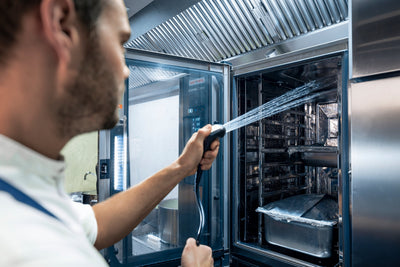
5. The hand shower. Most commercial combis have a retractable spray hose for rinsing the cabinet, deglazing trays and manual cleaning. It runs off the same supply.
Connecting the water supply
A combi oven connects to a cold mains supply through a 3/4" fitting, and it needs steady pressure within the manufacturer's range. For Rational combi ovens we recommend that range is 2 to 5 bar flow pressure.
Typical supply specification
|
Requirement |
Specification |
|---|---|
|
Supply |
Cold mains water, not hot |
|
Connection |
3/4" thread, flexible pressure hose |
|
Flow pressure |
2 to 5 bar |
|
Isolation |
Dedicated, accessible shut-off valve |
|
Treatment |
Filter or reverse osmosis unit if your water needs it, fitted before the oven |
Other brands are similar, but always check the installation manual for your specific model. Some models have two inlets: one for treated water to the steam generator and one for untreated water to the condenser and hand shower.
Getting the details right:
- Cold only. Connecting to hot water won't make steam faster. It upsets the condenser, which relies on cold water to work.
- Pressure. Measure it at the busiest time of day, when other equipment is drawing water. If it can exceed the maximum, fit a pressure-reducing valve. If it drops too low, the oven will show water supply faults mid-service.
- Isolation valve. Place it where staff and engineers can reach it without pulling the oven out.
- New hoses. Fit the hose set supplied with the oven rather than reusing an old one.
- Backflow protection. In the UK, appliances must not be able to contaminate the mains, under the Water Supply (Water Fittings) Regulations 1999 (Scottish Water Byelaws in Scotland). Many combis are WRAS-approved with protection built in, but some installations still call for a double check valve. Your plumber should confirm what's needed for your model and site.
Drainage: the half of the job people forget
Every combi needs a drain, and a poor drain causes more call-outs than a poor water supply. Most full-size ovens use a DN 50 (50 mm) waste connection; smaller tabletop units such as the iCombi Pro XS use DN 40.
The drain carries condensed steam, cooking juices, fat and cleaning chemicals, often while still hot. That shapes how it should be installed:
- Continuous fall. The pipe must run downhill all the way, with no dips where water and fat can sit. Level the oven first, because the oven's own position affects the fall.
- Heat-rated pipework. Waste water can leave the oven hot. Use pipe rated for hot waste rather than standard cold-waste plastic.
- No restriction. Don't reduce the pipe size or run it into a shared waste that is already busy. A blocked or slow drain pushes steam back into the cabinet and out of the door.
- Air gap or fixed connection. Depending on the model, the oven drains either into an open gully or into a fixed connection. We always recommend using a Tundish to create an air-gap. Follow the installation manual and your plumber's advice.
- Fat and grease. Roasting releases fat into the drain, which feeds grease build-up and can breach your water company's rules on fats, oils and grease. A grease trap downstream, or an oven with an integrated fat drain that collects fat separately, keeps this under control.
Stacked ovens need a drain outlet for each unit. How the two are combined is set out in the manufacturer's stacking kit instructions, so follow those rather than improvising.

Water quality: hardness, chlorides and why both matter
The quality of your water affects an oven's lifespan more than almost anything else, and two different problems are involved.
Limescale (hardness) - Hard water leaves calcium and magnesium deposits when it is heated. In a combi those deposits coat the steam generator, heating elements, sensors and spray nozzles. The result is slower steam, false readings and eventually component failure. Much of Kent and the South East has hard water, so this is a real issue for kitchens in our area.
Chlorides and chlorine (corrosion) - Salts in the water attack stainless steel, causing pitting and rust in the cooking chamber. A softener does not fix this, and some softeners can make it worse. Where chloride levels are high, manufacturers point to filtration or reverse osmosis instead; Rational's own guidance sets roughly 80 ppm chloride as the point where reverse osmosis is needed.
Water that is too pure - It sounds odd, but fully demineralised water causes problems too. Many steam generators detect their water level by conductivity, so they need some minerals present. Rational, for example, specifies a minimum conductivity of 50 μS/cm.
What to do in practice:
- Ask your water supplier for a water quality report covering hardness, chloride and chlorine. Most publish this by postcode.
- Match the treatment to the problem: a scale-reducing filter for hard water, reverse osmosis only where chlorides are high.
- Keep filter cartridges on a replacement schedule. An exhausted cartridge is the same as no filter.
How it works in a real kitchen
A combi needs water, a drain, power (and gas, for gas models) and extraction all meeting in one spot, so its position should be planned around services, not just floor space.
Positioning. Put the oven where the water supply, drain and electrics can reach the rear connections with short, direct runs. Long hose runs and long drain runs are where pressure drops and blockages start. Leave clearance at the sides and back for airflow and for an engineer to work, as set out in the installation manual.
Water and electrics together. The water connection and the electrical isolator often sit close together behind the oven. Combis are built to resist water jets (Rational ovens are rated IPX5), but the wall-mounted isolator and any sockets nearby need to be suitable for a wet kitchen and kept clear of the drain outlet.
Heat and steam. Steam vented from the oven and released when the door opens needs somewhere to go. A canopy or condensation hood over the oven protects ceilings, lights and nearby equipment.
Water treatment kit. If you fit a filter or reverse osmosis unit, mount it where cartridges can be changed without moving the oven.
What goes wrong without a proper water setup
Most water-related faults trace back to one of three causes: low pressure, poor water quality or a restricted drain.
|
Symptom |
Likely cause |
|---|---|
|
Water supply or "no water" error during service |
Pressure too low at peak times, a kinked hose or a closed or partly closed valve |
|
Weak steam, slow recovery after loading |
Scale in the steam generator or on the elements |
|
Inaccurate humidity or temperature readings |
Scale or deposits on sensors |
|
Cleaning cycle stops or leaves residue |
Low pressure, blocked spray nozzles or scale |
|
Steam escaping from the door or a smell from the drain |
Slow or blocked drain, or a drain without enough fall |
|
Rust spots or pitting in the cooking chamber |
High chloride water, or a softener adding salt to the supply |
|
Water pooling under the oven |
Leaking hose, or a drain backing up |
The good news is that nearly all of these are preventable at installation stage. Getting the supply, treatment and drain right on day one costs far less than replacing a steam generator later.
Buying a refurbished combi from CaterCombi
Every refurbished oven we sell has its steam generator, water inlet valves, condenser and drain system checked as part of the refurbishment, because these are the parts hard water and poor installation wear out first.
We stock refurbished Rational ovens alongside Electrolux, Convotherm and Eloma models, and we can help you work out what your site needs before you buy. If you are not sure whether your kitchen has the right water supply, pressure or drain for a combi, get in touch and we'll talk it through.
Frequently asked questions
Can I connect a combi oven to hot water? No. Combis are designed for a cold supply. The condenser depends on cold water to cool the exhaust and waste water.
Do I need a water softener? Not always. Many modern ovens descale themselves, and a softener does nothing for chlorides. Check your local water report first, then treat the specific problem.
Can I run a combi from a water tank instead of the mains? Standard commercial combis are built for a pressurised mains supply. A few compact models offer a tank option, but for a full-size oven you should plan for a mains connection.
Can the oven share a drain with my sink or dishwasher? Sometimes, if the shared pipe is large enough and has good fall. A drain that is already busy is a common cause of steam and smells coming back into the oven, so a dedicated drain is the safer choice.
Does a combi use water in convection-only mode? Yes, a little. The condenser still runs to cool the exhaust, and the cleaning cycle uses water regardless of how you cooked.
Who should install it? A qualified commercial kitchen engineer or plumber for the water and drain, a qualified electrician for the power, and a Gas Safe registered engineer for gas models.